what are you looking for?
A practical material-selection guide for skincare, sun care, cleansing, and personal-care brands
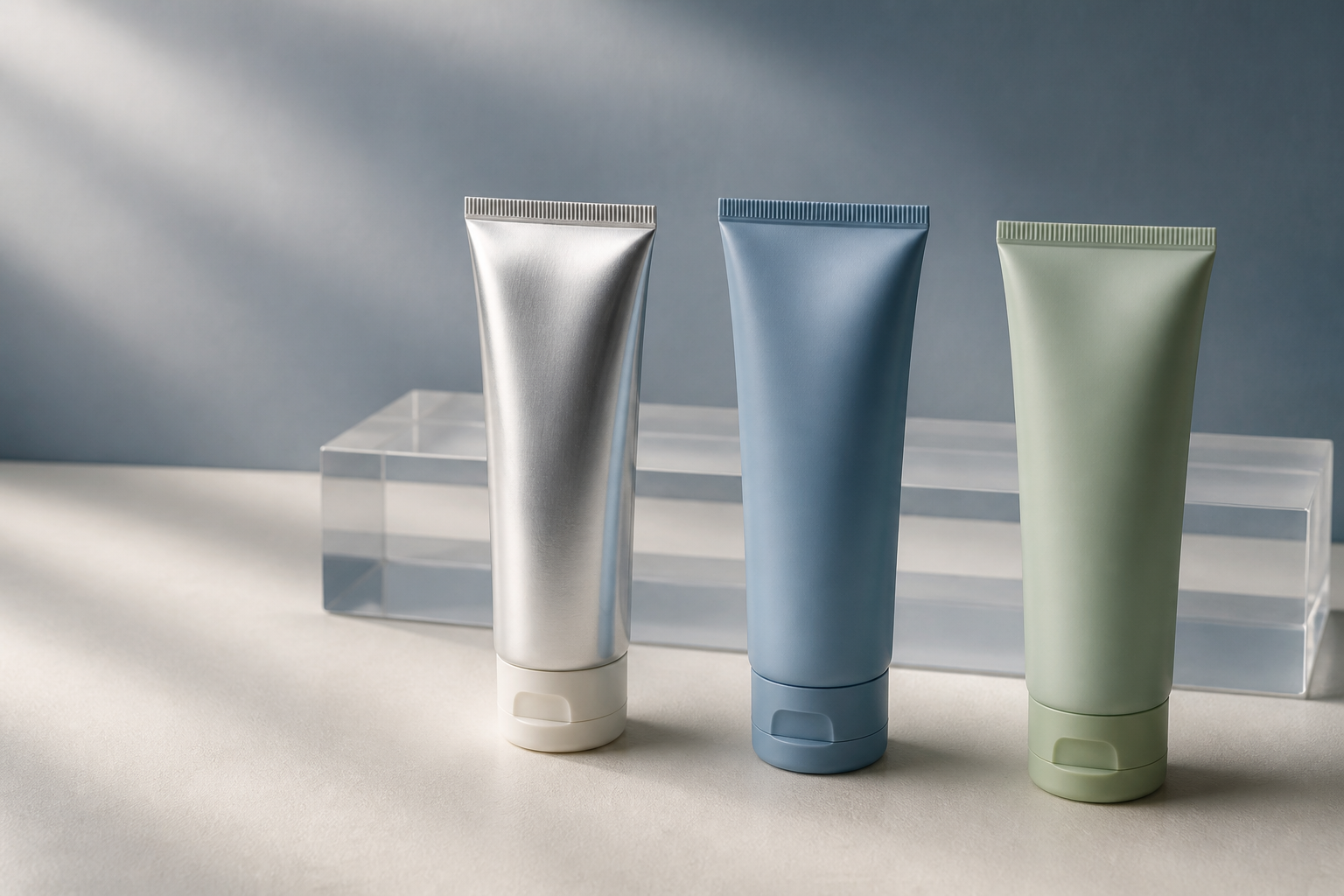
Editorial image: three unbranded cosmetic tube formats presented for a technical material-selection discussion.
A cosmetic tube has to do more than hold a formula. It must help protect the product, support clean and controlled dispensing, withstand filling and transportation, and communicate the brand's positioning through shape, decoration, and surface feel.
Different formulas create different packaging requirements. A light-sensitive or oxygen-sensitive product may call for a more protective structure. A daily moisturizer may place greater emphasis on squeeze feel, print quality, and efficient production. A premium treatment may require a balance between technical protection and a refined visual experience.
For this reason, material selection should begin with the formula and the intended use case—not with a tube name alone.
ABL tubes combine plastic layers with an aluminum foil barrier layer. The aluminum layer is used when the package needs strong protection from factors such as light, oxygen, and moisture.
ABL is often considered for products where formula protection is a high priority. It also offers a characteristic collapsible squeeze behavior: after the tube is compressed, it can retain the squeezed shape rather than fully returning to its original form.
The final suitability still depends on the formula, tube construction, closure, filling conditions, and target-market requirements.
PBL tubes use a plastic-based barrier layer within a laminated structure. The barrier layer may be designed to help limit oxygen transfer and manage interaction between the formula and the surrounding package layers.
Compared with ABL, PBL can provide a plastic-focused design direction and a smooth surface for high-quality decoration. Its squeeze behavior can be suitable for brands that want a flexible tube with a more stable return toward its original shape.
PBL is often evaluated for skincare, personal care, oral care, and other products where barrier protection and visual presentation are both important.
Co-extruded tubes are produced by extruding multiple plastic layers together to form the tube body. Unlike a laminated sheet that is cut and sealed, a co-extruded body can be produced without the same longitudinal seam structure.
Co-extruded tubes can provide flexible design options for plastic-layer construction and are often considered for cosmetic and personal-care products that require a clean appearance, controlled squeeze, and consistent tube production.
The actual performance depends on the selected layers, processing conditions, closure system, formula, and testing results.
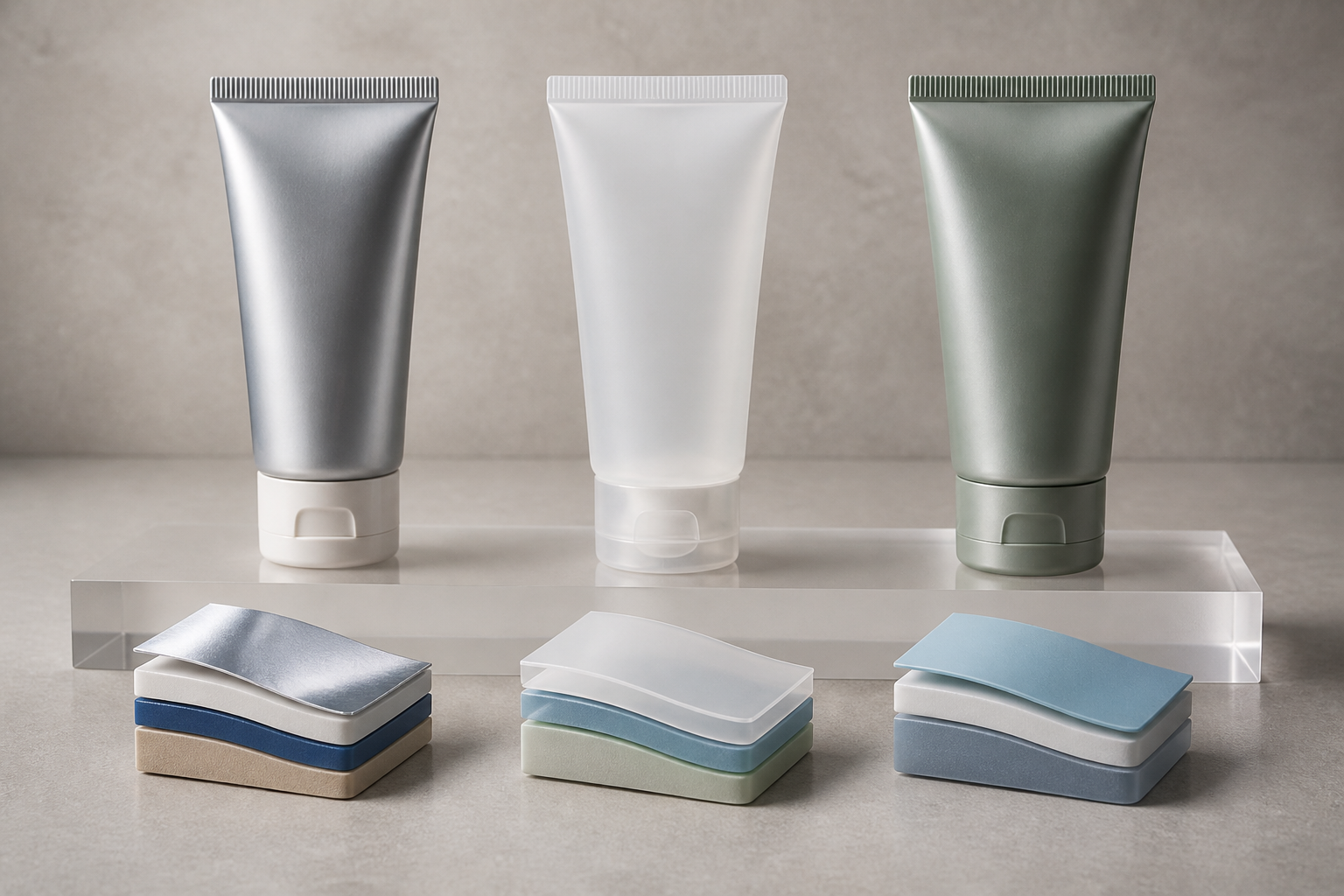
Editorial image: an abstract visual comparison of tube formats and material-layer concepts. It is illustrative and does not represent a specific production structure.
The table below is a starting point for buyer discussions. It is not a substitute for formula compatibility testing or a final technical specification.
| Decision factor | ABL | PBL | Co-extruded |
| Barrier concept | Aluminum foil barrier layer within a laminate structure | Plastic barrier layer within a laminate structure | Multiple plastic layers extruded together |
| Typical strength | Strong protection direction for light, oxygen, and moisture-sensitive products | Plastic-based barrier approach for products requiring protection and visual quality | Flexible multilayer plastic approach with a clean body construction |
| Squeeze behavior | Can retain a compressed shape | Can return toward its original shape | Can return toward its original shape, depending on construction |
| Decoration | Supports a wide range of tube decoration options | Smooth surface can support high-quality printing | Clean surface and consistent body appearance can support premium presentation |
| Sustainability discussion | Requires review of the complete multilayer package and recovery pathway | Can support a plastic-focused strategy; complete structure still needs review | Requires review of the selected layers, closure, decoration, and local recovery route |
| Best starting question | Does the formula require a stronger barrier direction? | Can a plastic barrier structure meet the protection and appearance goals? | Can the selected plastic-layer construction meet the formula and production requirements? |
For face creams, hand creams, masks, and targeted treatments, buyers usually need to balance formula protection with a comfortable squeeze and a premium appearance.
A practical evaluation may compare PBL, co-extruded, and PE-based options. If the formula is especially sensitive to light, oxygen, or moisture, an ABL option may also be reviewed. The final direction should be supported by compatibility and stability-related evaluation rather than by category assumptions alone.
Sun-care packaging should be reviewed together with the formula, filling conditions, dispensing behavior, and expected storage environment. Barrier considerations may be important, but a suitable tube also needs to provide a reliable seal, comfortable handling, and controlled dispensing.
Cleansers, shower products, and body lotions often place strong emphasis on squeeze feel, cap usability, leak prevention, and efficient production. A PE extrusion, PBL, or co-extruded direction may be considered depending on the formula and the brand's technical brief.
Small makeup tubes, concealer tubes, and targeted applicator formats require accurate dispensing and strong visual differentiation. In these applications, the cap, nozzle, applicator, decoration, and tube diameter should be assessed as one package system.
Cosmeceutical and pharma-cosmetic products
For products with sensitive actives or more demanding protection requirements, the buyer may need a deeper review of barrier structure, formula compatibility, seal integrity, and documentation. ABL, PBL, and co-extruded options can be compared only after the product requirements are clearly defined.
A buyer's decision framework
Step 1: Define the formula profile
Prepare the product type, viscosity, active ingredients, fragrance profile, sensitivity to light or oxygen, filling temperature, and expected storage conditions.
Step 2: Define the user experience
Decide how the tube should feel in the hand, how quickly it should recover after squeezing, how precisely it should dispense, and whether the package should stand, lie flat, or support a special applicator.
Step 3: Define the visual direction
Consider the tube shape, surface finish, printing method, color coverage, metallic effect, matte or soft-touch feel, and the required level of artwork detail.
Step 4: Review sustainability requirements
Clarify whether the priority is material reduction, PCR content, a plastic-focused structure, simplified material separation, or communication that can be supported in the target market.
Step 5: Test the complete package
Review the tube body, shoulder, cap, nozzle, seal, decoration, and formula together. Samples should be checked under the intended filling, storage, and transportation conditions.
Questions to ask your cosmetic tube supplier
1.Which tube structure is being proposed, and what are its main layers?
2.What formula conditions were considered during the recommendation?
3.How does the tube behave during squeezing, filling, sealing, and transportation?
4.Which decoration methods are compatible with the selected structure?
5.Is the sustainability statement related to the tube body or the complete package?
6.Which components may influence recycling or recovery in the target market?
7.Can the supplier provide samples representing the intended production structure?
8.Which technical documents and test results are available for review?
9.Can the tube be customized for the required diameter, capacity, cap, nozzle, and finish?
10.What changes may occur in appearance or processability when alternative materials are used?
From material comparison to a production-ready decision
A well-organized development process can follow this sequence:
Formula brief → Structure shortlist → Sample comparison → Formula-package evaluation → Filling trial → Technical review → Production preparation
This process gives the buyer a clear opportunity to compare not only the tube body, but also the complete user experience and production performance.
It also helps avoid a common mistake: selecting a structure based only on a single benefit, such as barrier protection, recyclability, printing, or low material use. A successful cosmetic tube has to perform as a complete package.
Conclusion
ABL, PBL, and co-extruded tubes each offer a different starting point for cosmetic packaging development.
The best choice is not the same for every product. The right structure is the one that matches the formula, user experience, manufacturing process, sustainability objective, and target market.
Request a tube structure review
Not sure whether ABL, PBL, or co-extruded tubes are suitable for your product? Prepare your formula type, target capacity, preferred diameter, closure concept, decoration direction, and target market.
Suggested CTA: Request a tube structure review and sample discussion from your packaging team.

 Add: No. 21, Lane 10, Yongxing Middle Road, Taihe Town, Baiyun District, Guangzhou, China
 Mobile:+86 -18594043134
 Email: cecilia@huccipack.com
 Whatsapp: +8618594043134


 Apply Free Sample




 Get Free Sample